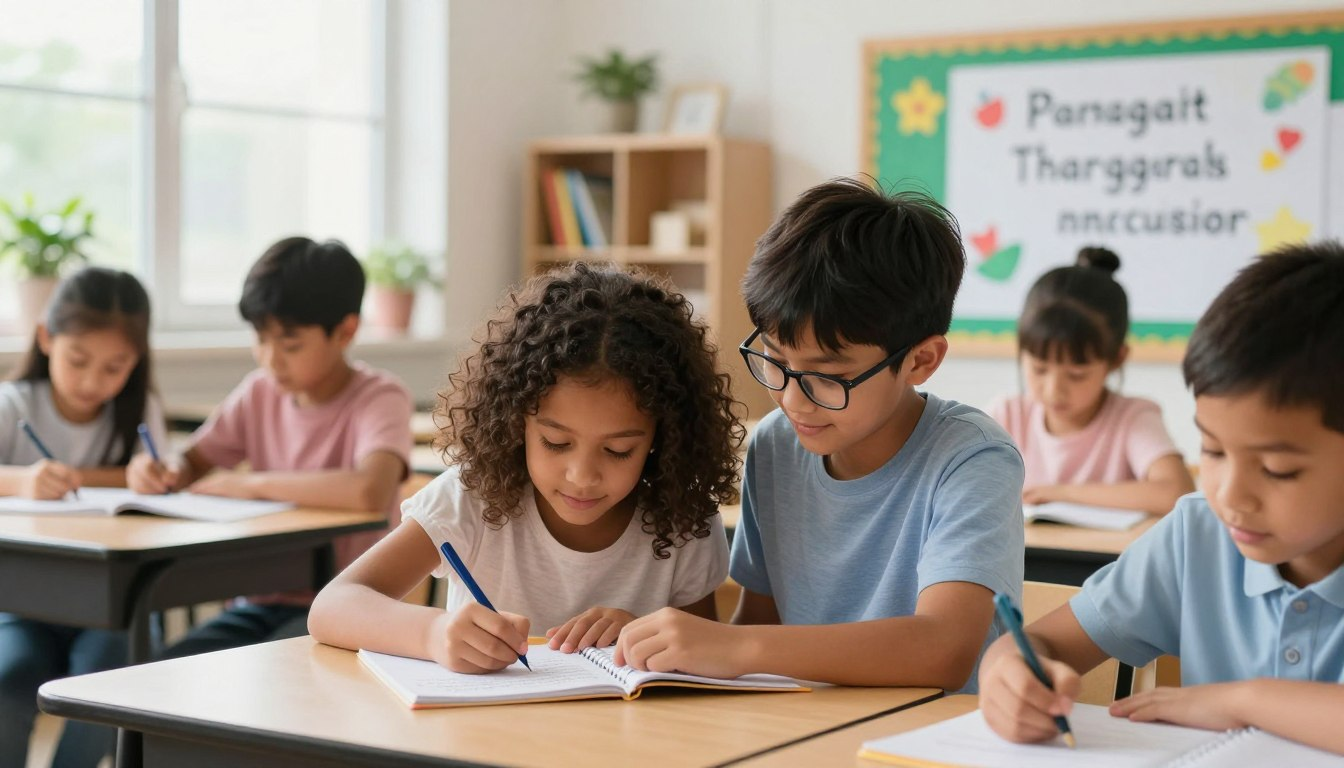
Learning to write well is very important. When you learn how to write a paragraph for kids, you can share your ideas with everyone.
Think of your writing as a building. It needs a strong base, solid walls, and a good roof. With a simple plan, you can make your thoughts clear and strong.
We will look at the key parts of a story, starting with the first sentence. You will learn how to make great sentences that lead to a strong ending. Let’s start this journey to become a better storyteller today.
Understanding the Basics of Paragraph Writing

Paragraph writing for kids is key to making simple ideas clear. It turns random sentences into a strong way to share thoughts.
Think of a paragraph as a fundamental building block of your writing. It’s not just random sentences. It’s a unit that holds one main idea from start to finish.
What is a paragraph?
A paragraph is a group of sentences that explain one topic. It starts with a clear opening, has supporting details, and ends with a closing thought.
By focusing on one idea, it’s easier for readers to follow. Every sentence should support the main theme to keep your writing strong.
Why structure matters for young writers
Structure is key because it keeps ideas clear and organized. It shows you have a logical plan for your story or report.
Without structure, even great ideas can get lost. Learning to organize your thoughts early makes you a better writer.
Preparing to Write: Brainstorming and Planning

Great writing starts long before you write your first sentence. Taking a few moments to think through your ideas makes the process more fun. These easy kids paragraph writing tips will help you turn a blank page into a masterpiece with confidence.
Choosing a topic that excites you
The best paragraphs come from writers who care about their subject. When you pick a topic you find interesting, your enthusiasm will show. You’ll find it easier to come up with fun facts and details when you love what you’re writing about.
Try to brainstorm a list of things that make you curious or happy. It could be your favorite sport, a cool animal, or a hobby you enjoy. Your passion is the best starting point. Remember, your voice matters, and writing about your interests is the best way to share it with others.
Using graphic organizers to map ideas
Once you have a topic, it’s time to organize your thoughts with a visual tool. Graphic organizers act like a map for your writing, showing where each piece of information should go. Using these tools is one of the most effective easy kids paragraph writing tips for young students.
You can use different types of organizers to help structure your work. Here are a few ways they help you succeed:
- Visualizing connections: See how your main idea links to your supporting details.
- Reducing stress: Break a big task into smaller, manageable boxes.
- Improving flow: Ensure your sentences follow a logical order before you start drafting.
By mapping out your ideas first, you avoid getting stuck in the middle of a sentence. This simple planning step ensures your final paragraph is clear, organized, and ready to impress your readers.
Crafting the Perfect Topic Sentence

Think of your topic sentence as the anchor that holds your paragraph together. It shows your reader what’s coming next. When teaching kids to write paragraphs, this sentence is the base for all other details.
Defining the main idea
The main idea is what you want to share. It should be clear and not too broad. A good topic sentence tells the reader what to expect without giving too much away.
If your topic is too wide, your paragraph might get confusing. Tell young writers to choose a clear subject, like “why dogs make the best pets.” This makes writing easier for everyone.
How to write a hook that grabs attention
A hook is the first part of your sentence that grabs the reader’s attention. You want them to feel excited to keep reading. There are many ways to make a hook stand out.
Start with a surprising fact or a question that makes them think. For example, “Did you know that honey never spoils?” is more interesting than “Honey is a sweet food.” A bold statement or a short, punchy quote can also grab their attention.
Developing Supporting Details

Now that you have a topic, let’s fill your paragraph with helpful information. Learning the right paragraph structure for children turns a simple idea into a powerful message.
Selecting the best facts and examples
When you write, pick facts that prove your point well. Think of your supporting details as the bricks that build a strong wall. If the bricks are weak or don’t fit, the wall might fall down.
Always ask yourself if a fact helps the reader understand your main idea better. If it is just a random piece of information, it is better to leave it out. Using clear examples makes your writing much more persuasive.
“The secret of good writing is to say things clearly and keep your reader interested in every single sentence.”
— Anonymous
To help you choose the best details, look at this comparison table below:
| Type of Detail | Why it Works | Example |
|---|---|---|
| Specific Fact | Provides proof | “Dogs have a sense of smell 10,000 times better than humans.” |
| Personal Example | Makes it relatable | “My dog once found my lost keys in the tall grass.” |
| Irrelevant Fact | Causes confusion | “I like to eat pizza on Friday nights.” |
Keeping sentences focused on the topic
It is very easy to start writing and suddenly wander off into a different story. To maintain a solid paragraph structure for children, every sentence must connect back to your main idea. If you find yourself writing about something else, stop and ask if it belongs in a new paragraph instead.
Staying focused keeps your writing organized and easy to follow. When you keep your sentences on track, your reader will always know exactly what you are trying to say. Remember, a great paragraph is like a team where every player works toward the same goal.
The Importance of Transition Words
Transition words make your writing flow smoothly. Without them, your text might seem like a bunch of random facts. They help your writing activities for young writers sound professional and keep readers interested.
Connecting ideas smoothly
Transition words are like glue for your paragraphs. They tell the reader when you’re adding new info, showing differences, or ending. Using them right makes your writing smooth and easy to follow.
Learning to use these words is key for students. It makes your writing clear and keeps readers on track. With practice, your paragraphs will become more connected and enjoyable to read.
Common transition words for kids
You don’t need fancy words to write well. Simple, clear words work best. Here’s a list of common transitions to help your sentences flow together.
| Purpose | Transition Words | Example Usage |
|---|---|---|
| Adding Ideas | Also, Further, In addition | I like pizza; also, I love tacos. |
| Showing Contrast | But, On the other hand, Yet | It was sunny; but it was cold. |
| Showing Time | First, Next, Last | First, we baked the cake. |
| Concluding | So, In summary, Lastly | So, we should go home. |
Try using these words in your next writing activities for young writers session. You’ll see how your writing gets better and more polished. The goal is to make your writing easy for everyone to understand.
How to write a paragraph for kids using the OREO method
Learn how to write a paragraph for kids with the OREO method. It’s easy and fun. This method helps you organize your thoughts well.
Opinion: Stating your view
The first step is to share your opinion. This is what you mainly want to say about your topic.
Think of this as your opening statement. You should clearly tell the reader what you believe or feel.
Reasons: Why you think that way
Next, give strong reasons for your opinion. Ask yourself why you feel that way.
Listing your reasons helps the reader see your point. Try to give at least two or three good points to make your argument stronger.
Examples: Providing evidence
Now, back up your reasons with examples. Evidence makes your writing believable.
You can use facts, personal stories, or observations to prove your point. Good evidence connects your reasons to the reader’s mind.
Opinion: Restating your point
Lastly, restate your opinion to wrap it up. This reminds the reader of your main message.
By using this final step, you make sure your message stays with the reader. Learning how to write a paragraph for kids this way will make you a confident writer.
Writing the Concluding Sentence
You’ve made your case, and now it’s time for a final sentence. This is your last chance to show why your topic is important. It makes your writing feel complete and polished.
Summarizing the main point
When you summarize, you want to say your main idea in a new way. Don’t just copy your topic sentence. Use different words to say the same thing.
This is like a quick recap for your reader. You’re making sure they remember your main point. Here are some tips for a strong summary:
- Use synonyms to describe your main topic.
- Focus on the most important reason you provided.
- Keep the sentence short and punchy for maximum impact.
Leaving the reader with a final thought
A great conclusion does more than just summarize. It leaves the reader thinking. You might share a final opinion, a call to action, or a fun fact. This memorable ending makes your writing stay with the reader.
By mastering this part of the paragraph structure for children, you turn simple sentences into a complete story. Always aim to end strong. A strong finish shows you’re confident in your ideas.
Editing and Revising Your Work
Every great writer starts with a first draft. Then, they take time to review their work. This makes their writing polished and clear.
Checking for spelling and grammar
After you write, it’s time to be a detective. Check your sentences for spelling and punctuation. Correct grammar helps your readers understand you better.
If you’re not sure about a word, use a dictionary or spell-check. These tools help make your writing look professional. Taking this extra step improves your work a lot.
Reading aloud to hear the flow
Reading your work out loud is a great way to find mistakes. You might notice sentences that sound awkward. Reading aloud helps you catch these issues.
If you struggle with a sentence, rewrite it. Listen for the rhythm of your words. This makes your writing smooth and confident.
Fun Paragraph Writing Exercises for Kids
Learning to write is more fun with a little creativity. It’s important to practice often. But, it should never feel like a chore. By using fun paragraph writing exercises for kids, every practice session can be exciting.
Creative writing prompts
Imaginative prompts are great for paragraph writing for kids. They offer a chance to use writing skills in new ways. You might ask them to write about a secret base on the moon or how to train a pet dragon.
“The secret of getting ahead is getting started.”
Mark Twain
These prompts help kids focus on their main points and details. Here are some ideas to start:
- Write about your favorite superpower.
- Explain how to make the perfect ice cream sundae.
- Describe a day in the life of a talking squirrel.
Collaborative writing games
Writing with friends can really boost confidence. Games that involve teamwork help students learn from each other. They see how different people tackle the same writing task.
Try “Pass the Paragraph” where each adds a sentence before passing it on. This game makes sure everyone understands how to write well together. It’s a dynamic way to learn.
Common Challenges and How to Overcome Them
Every young writer hits a wall sometimes, but you can learn to climb over it. When teaching kids to write paragraphs, it is important to remember that feeling stuck is a normal part of the creative process.
Dealing with writer’s block
Writer’s block happens when your brain feels like it has run out of ideas. If you feel this way, try taking a short break to stretch or grab a glass of water. Stepping away from your desk often helps your mind reset.
Another great trick is to use a brainstorming list. Write down five things you know about your topic, even if they seem small. Once you have a list, you will find it much easier to start your first sentence.
Fixing run-on sentences
A run-on sentence happens when two or more complete thoughts are joined together without the right punctuation. This can make your writing hard to follow. Keeping your sentences focused on one idea at a time is the best way to avoid this mistake.
To fix a run-on, look for places where you can add a period to create two separate sentences. You can also use connecting words like “and” or “but” to join ideas smoothly. Practice makes perfect when you are teaching kids to write paragraphs, so keep checking your work for clarity.
Tools and Resources for Young Writers
Writing is more fun with the right tools. The right resources boost your productivity. They help you learn easy kids paragraph writing tips with ease.
Digital tools for drafting
Today’s tech makes organizing ideas easy. Simple word processors with spell-checkers let you focus on being creative.
Digital mind-mapping apps are also great. They help you arrange your thoughts in a clear order. These tools are incredibly helpful for making your ideas flow smoothly.
Printable templates and checklists
A physical guide can be very helpful. Printable templates show you where to put your ideas. They help you keep your writing in order.
Checklists are another great tip. They make sure you don’t forget anything. By checking off each step, you’ll know you’ve done a great job.
Conclusion
Starting good writing habits early is key to success. You can turn simple thoughts into clear messages. With practice, you’ll feel more confident in your writing.
Every paragraph you write lets you share your view with the world. You can use Google Docs or a notebook. Just focus on your structure and keep your ideas clear.
Think about how far you’ve come as a young writer. You know how to plan, draft, and polish your work. These strategies will help you grow in school.
Begin your next writing project today. What topic will you choose? Grab your pen or open your laptop and start your next story now.
FAQ
Q: What are some easy kids paragraph writing tips for beginners?
A: Start with the OREO method to organize your thoughts. Always have a strong topic sentence first. Make it easy by focusing on one main idea at a time.Use transition words like “first,” “next,” and “last” to link your sentences.
Q: How can I begin teaching kids to write paragraphs effectively?
A: Explain that a paragraph is like a building block. It holds your thoughts together. Use graphic organizers or tools like Google Docs to help them plan before they write.
Q: What is the most recommended paragraph structure for children?
A: For kids, start with a topic sentence (the hook). Then add three supporting sentences with facts or examples. End with a concluding sentence that wraps up the main idea.
Q: Are there any specific writing activities for young writers to improve their skills?
A: Yes! Try collaborative writing games with your child. Take turns adding sentences. Use Scholastic Story Starters for fun prompts that make writing a game.
Q: What are the best kids writing strategies for revising a draft?
A: Read your paragraph aloud. This helps you catch awkward phrasing and run-on sentences. Use Grammarly or a spellchecker to find grammar mistakes.
Q: Where can I find fun paragraph writing exercises for kids?
A: Check out PBS Kids or Education.com for fun exercises. Ask your child to write a paragraph to convince you to buy a LEGO set or a Disney toy. Use the OREO method to build their argument.
Q: Why is the topic sentence considered the anchor of the paragraph?
A: The topic sentence clearly states the main idea. It grabs the reader’s attention with a hook. This keeps them interested in the supporting details that follow.
Q: How do transition words help in paragraph writing for kids?
A: Transition words connect your thoughts. They help young writers move smoothly from one idea to the next. This keeps the writing clear and flowing.