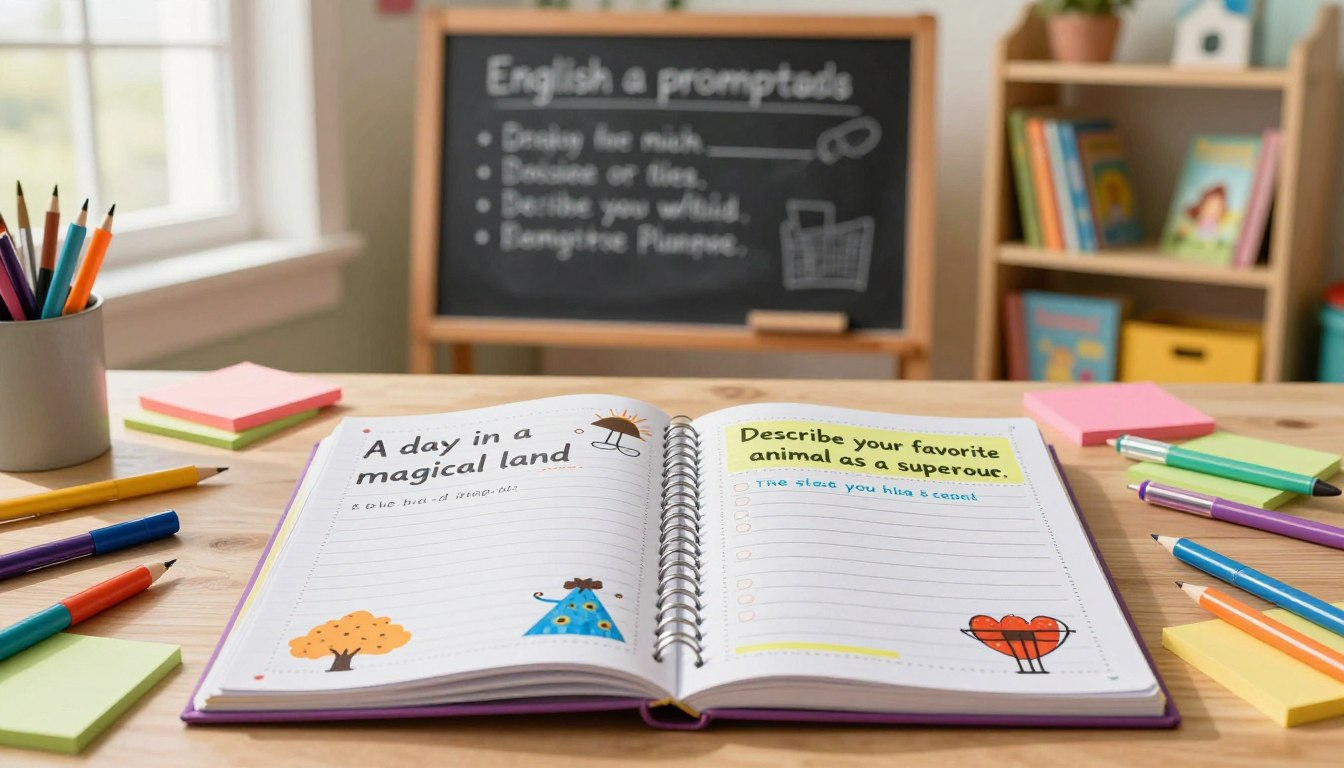
Maya Angelou once said, “You can’t use up creativity. The more you use, the more you have.” This shows why it’s important to help young minds grow.
Helping pre-teens find their voice helps them talk better and feel more confident. These literacy tools spark curiosity. They help teens explore deep thoughts through stories.
Using structured organizers helps students organize their ideas better. This guide has 50 story starters and templates. It makes learning fun and exciting.
Good english writing prompts for kids 10+ help improve literacy and self-expression. Let’s see how these tools can make learning fun and inspire a love for books.
Key Takeaways
- Inspire creative thinking through diverse story starters.
- Expand vocabulary and improve sentence fluency naturally.
- Develop organizational skills using structured planning templates.
- Boost self-confidence in communication and literacy.
- Encourage critical thinking and deep self-expression in pre-teens.
- Provide a fun and low-pressure environment for learning.
Why Writing Prompts Matter for Young Writers
Young writers often feel scared when they see a blank page. But, the right prompts can help them start. These prompts give them a clear direction, helping them to think and write better.
Inspiring prompts are great for young writers. They spark creativity and help improve writing skills. These prompts make young writers think deeply and write more clearly. This boosts their confidence in writing.
Renowned educator and author,
“The most important thing in writing is to have written.” –
Lucy Calkins
This quote shows how important it is to start writing. Inspiring prompts help young writers do just that.
Using writing prompts has many benefits for young writers:
- Boosts creativity and imagination
- Enhances critical thinking and problem-solving skills
- Improves writing confidence and fluency
| Benefits | Description |
|---|---|
| Creativity Boost | Prompts stimulate young writers to think creatively and explore different writing styles. |
| Critical Thinking | By responding to prompts, young writers develop their critical thinking skills, analyzing situations and forming opinions. |
| Confidence Building | Regular writing practice with prompts helps build confidence in young writers, making them more proficient in expressing themselves. |
By using inspiring prompts, you can help young writers find their voice. This makes writing more fun and rewarding for them.
Benefits of Regular Writing Practice for Kids 10 and Older
Doing fun writing activities for tweens boosts their confidence and lets them express themselves well. Writing often helps kids learn important skills that last a lifetime.
Writing regularly makes communication skills better. Kids learn to share their thoughts and ideas clearly. This skill helps them talk and write better to others.
Writing also enhances creativity. Kids get to think creatively with writing prompts. This creativity can help them in school and life.
Writing lets kids share their feelings and thoughts safely. This is great for pre-teens as they figure out who they are.
Writing also sharpens critical thinking skills. Kids learn to analyze and think deeply. These skills are useful in school and life choices.
Make writing fun for your child. It helps them grow and love writing and self-expression for life.
Understanding Writing Planning Templates
To help kids write better, it’s key to use writing planning templates. These templates give a clear plan for writing. They help young writers organize their ideas.
Using printable writing prompts for young students with these templates makes writing fun. It lets kids focus on their creativity, not just the writing itself.
What Makes a Good Planning Template
A good template is easy to understand and fits the writing task. It breaks down writing into parts like brainstorming and outlining.
It also makes kids think deeply about their writing. For example, templates with creative writing ideas for children spark their imagination.
Types of Planning Templates for Different Writing Styles
There are many planning templates for different writing styles. For example, narrative templates help with characters and plots.
Descriptive templates focus on what we see, hear, and feel. The right template helps kids write better and more interestingly.
- Narrative writing templates for storytelling
- Descriptive writing templates for vivid descriptions
- Persuasive writing templates for argumentative essays
- Expository writing templates for informative pieces
By using these templates, kids can become better and more confident writers.
Creative Narrative Writing Prompts

Writing exercises for preteens can be fun and creative. They help kids write about their lives. This makes them think, remember, and share important moments.
Writing stories is a great way for kids to express themselves. They can try different types of stories. This lets them find what they like to write about.
Adventure and Fantasy Prompts (Prompts 1-5)
Adventure and fantasy prompts spark the imagination. Here are five prompts to start with:
- You stumble upon a hidden world within your reflection. What do you find there?
- Imagine you are on a quest to find a legendary treasure. Describe your journey.
- You have been given the power to fly. Where do you go and what do you see?
- Write about a character who discovers a magical object that changes their life.
- You are transported to a fantasy realm. Describe the creatures and landscapes you encounter.
Realistic Fiction Prompts (Prompts 6-10)
Realistic fiction prompts connect kids to their everyday lives. Here are five prompts to try:
- Write about a memorable day from your childhood. What made it so special?
- Describe a challenge you faced and how you overcame it.
- Imagine you are given the opportunity to spend a day with your future self. What do you learn?
- Write a story about a friendship that taught you something valuable.
- Describe a place that holds sentimental value to you. Why is it so important?
These narrative writing prompts are engaging and thought-provoking. They help preteens improve their writing while exploring their creativity.
Descriptive Writing Prompts for Young Authors
Descriptive writing prompts help your child be creative and improve their writing. It’s about using senses to make scenes or characters come alive. This skill is key for young writers to engage readers and share their ideas well.
These prompts make writing more fun and detailed. They help young authors use words to paint pictures in readers’ minds.
Sensory Experience Prompts (Prompts 11-15)
Sensory prompts are great for improving descriptive writing. They ask your child to describe what they see, hear, smell, taste, and feel.
- Prompt 11: Describe a memory from a family vacation that is linked to a specific smell.
- Prompt 12: Write about a place you’ve visited that was very noisy, and describe the sounds you heard.
- Prompt 13: Imagine you’re eating your favorite meal. Describe the taste, texture, and smell of the food.
- Prompt 14: Describe a season of the year from the perspective of a specific sense (e.g., what winter feels like on your skin).
- Prompt 15: Write about a time when you felt a strong emotion. How did your body feel?
Character and Setting Description Prompts (Prompts 16-20)
These prompts help your child describe people and places in detail. They encourage creative thinking and using descriptive language.
| Prompt | Description |
|---|---|
| Prompt 16 | Describe a character’s appearance, personality, and background. |
| Prompt 17 | Write about a fictional place you’ve created. Describe its geography, climate, and features. |
| Prompt 18 | Describe a historical figure. What did they look like? What were their achievements? |
| Prompt 19 | Imagine you’re describing your dream house. What does it look like? What features does it have? |
| Prompt 20 | Write a character sketch of someone you admire. What qualities do they possess that you admire? |
Using these prompts, you can help your child improve their writing and think creatively about the world.
Persuasive and Opinion Writing Prompts

It’s important for kids to share their thoughts and reasons. Persuasive writing helps them do this. It makes them better at talking and writing.
Persuasive writing is more than just saying what you think. It’s about giving good reasons and evidence. This skill is useful every day, like convincing friends or writing essays. It helps kids think better, see different views, and talk more clearly.
School and Community Topics
There are many good topics for persuasive writing. These topics are close to kids’ lives. Here are some examples:
- Should schools have uniforms?
- Should there be more recycling programs in your community?
- Should homework be banned?
- Should there be stricter rules for using technology at school?
- Should your school have more extracurricular activities?
These topics help kids think deeply about their world. By arguing for or against these ideas, they learn to support their opinions well.
| Prompt | Possible Arguments For | Possible Arguments Against |
|---|---|---|
| Should schools have uniforms? | Promotes equality, reduces bullying | Restricts personal expression, can be costly |
| Should there be more recycling programs? | Helps the environment, promotes sustainability | Can be costly to implement, may not be effective |
| Should homework be banned? | Reduces stress, allows more free time | Reinforces learning, prepares for exams |
Personal Choice and Preference Prompts
Personal choice prompts let kids show who they are. They can write about what they like. It’s a fun way to share their thoughts.
- What is your favorite season, and why is it the best?
- Should your favorite book be made into a movie?
- What is the best way to spend a free Saturday?
- Should your school cafeteria serve more of your favorite foods?
- What is the most important quality in a friend?
Writing about what they like helps kids get better at arguing. It’s a fun way to practice.
Using these prompts, you can help your kids improve their writing and thinking. Encourage them to explore different topics and share their opinions confidently.
Reflective and Personal Writing Prompts
Writing helps kids understand themselves and the world. It lets them share their thoughts and feelings safely. Journaling is great for this because it’s a private space to express emotions.
Writing about themselves helps kids know themselves better. It lets them discover their feelings and experiences. This way, they can learn from their memories and experiences.
Self-Discovery Prompts
Self-discovery prompts help kids learn about themselves. They think about who they are and what they want. Here are some prompts:
- What are your strengths and weaknesses, and how do they impact your daily life?
- What are your long-term goals, and what steps can you take to achieve them?
- Describe a challenging experience you’ve had and what you learned from it.
- What are some things you’re passionate about, and how do you incorporate them into your life?
- Write about a role model in your life and what qualities you admire about them.
These inspiring prompts for young writers help them understand themselves better.
Memory and Experience Prompts
Memory and experience prompts ask kids to think about important times. Writing about these helps them understand their feelings. Here are some prompts:
- Describe a happy memory from your childhood and why it’s significant to you.
- Write about a difficult experience you’ve had and how you overcame it.
- What’s the most important lesson you’ve learned from a family member or friend?
- Describe a place that holds special meaning to you and why it’s important.
- Write about a time when you felt proud of yourself and what you accomplished.
Reflecting on memories helps kids understand themselves and their feelings.
| Prompt Type | Example Prompts | Benefits |
|---|---|---|
| Self-Discovery | What are your strengths and weaknesses? | Encourages self-awareness and personal growth |
| Memory and Experience | Describe a happy memory from your childhood. | Helps process emotions and gain new insights |
Imaginative and What If Scenario Prompts

Writing exercises for preteens often include fantastical scenarios and ‘what if’ situations. These prompts help young writers think creatively and use their imagination. They can write unique stories that show their innovative ideas.
Imaginative writing prompts spark curiosity and inspire creativity. They help preteens think critically and explore different writing styles. Kids can write stories that take readers to new worlds.
Science Fiction and Future Prompts (Prompts 41-45)
Science fiction and future prompts ask kids to imagine different realities and tech advancements. These prompts help young writers build worlds and think about the future.
- Prompt 41: You find a time machine that takes you to 2154. Describe your experiences.
- Prompt 42: Imagine a world where robots do most human tasks. How does society change?
- Prompt 43: You get to colonize a new planet. What does your new home look like?
- Prompt 44: Write about a future where virtual reality is real.
- Prompt 45: Imagine humanity meets alien life. What happens next?
Magical and Impossible Situation Prompts (Prompts 46-50)
Magical and impossible situation prompts let kids explore fantasy and the extraordinary. These exercises help young writers get creative and improve their storytelling.
Here are a few magical and impossible situation prompts:
| Prompt Number | Prompt Description |
|---|---|
| 46 | You find a magical object that grants wishes. What are the consequences? |
| 47 | Imagine you can fly. Describe your adventures. |
| 48 | You can talk to animals. What do you learn? |
| 49 | Write a story about a world without gravity for a day. |
| 50 | You are in your favorite book or movie. What happens? |
These prompts are meant to inspire creativity and encourage young writers to explore new ideas. By doing these exercises, preteens can improve their writing and imagination.
How to Use English Writing Prompts for Kids 10+ Effectively
To get the most out of printable writing prompts for young students, it’s key to know how to use them well. These prompts can make writing fun and help your child improve their skills. But, it needs a careful approach.
Think about your child’s age, likes, and writing level when you start. This makes the experience better and more fun for them.
Setting Up a Writing Routine
Creating a regular writing time is very important. Pick a special time and place for writing. This helps make writing a fun habit.
Begin with short times, like 15-20 minutes. Then, you can make it longer as your child gets more into it. Writing together as a family can also be very motivating.
Choosing the Right Prompt for Your Child
Choosing the right prompt can be hard. Think about what your child loves. If they love animals, pick a prompt about pets or creatures.
Also, think about how hard the prompt is. Some might be too simple or too hard. You can make it easier or harder by adding or removing things.
Combining Prompts with Planning Templates
Planning templates are great with writing prompts. They help your child organize their ideas and write better.
Using prompts and templates together helps your child write better. It makes them more confident in their writing.
Encourage your child to try different prompts and templates. This helps them find what they like best. It makes writing more fun and rewarding.
Step-by-Step Guide to Using Planning Templates

To get the most out of creative writing ideas for children, it’s key to know how to use planning templates. These templates are like a map for young writers. They help them move through the writing process easily and with confidence.
Brainstorming Stage
The first step is brainstorming. Tell your child to think of ideas without fear of mistakes. Set a time limit to keep it fun and focused. This stage is all about coming up with lots of ideas for the writing prompt.
For example, if the prompt is about a magical kingdom, your child might think of its people, magical creatures, and challenges. The goal is to gather lots of ideas to organize and develop later.
Organizing Ideas
After getting a list of ideas, it’s time to organize them. This means grouping ideas into themes or sections for the story’s structure. A planning template helps your child see how ideas connect and which ones fit best.
They might sort ideas into groups like characters, settings, and plot twists. This makes it easier to see how the story will come together and what needs more work.
Drafting and Revising
With a good plan, your child can start writing their story. The planning template helps them create a story that flows well. After writing the first draft, it’s time to revise. Encourage your child to check their work, make changes, and edit for better clarity and grammar.
Revising is key to making the story better. It’s a chance to refine the story, ensuring it’s engaging and well-structured. It also helps check for consistency and flow, making the story smooth and fun to read.
To show how planning templates help, let’s compare:
| Stage | Without Planning Template | With Planning Template |
|---|---|---|
| Brainstorming | Ideas are scattered and hard to manage. | Ideas are captured and organized systematically. |
| Organizing | Difficulty in structuring the narrative. | Clear structure and connection between ideas. |
| Drafting and Revising | Challenges in maintaining coherence. | Easier to draft and revise with a clear plan. |
By following these steps and using a planning template, your child can improve their writing. They’ll create high-quality creative writing.
Tips for Encouraging Reluctant Writers
Make writing fun for your child by using their interests. Make it a place where they feel free to write without worry. Fun writing activities for tweens that match their life can really help.
Making Writing Fun and Pressure-Free
To make writing fun, take away the stress. Set up a fun writing station with cool pens, stickers, and different papers. This makes writing more fun and less scary.
Use writing prompts that your child loves. If they like adventure stories, give them prompts to write about new worlds. Make writing fun and interactive.
Celebrating Progress Over Perfection
Focus on progress, not perfection. Praise your child for trying and show them the value of the journey. Display their work proudly, like on a fridge or bulletin board.
This way, your child sees writing as a journey, not a race. This can help them love writing more.
Creating Your Own Custom Writing Prompts
Make writing fun for your child by creating prompts that match their interests. This makes them more excited to write.
When you make prompts about things your child loves, it sparks their creativity. For example, if they love animals, you can write about adventures with pets or exploring animal habitats.
Using Your Child’s Interests
Start by finding out what your child loves. Do they like science fiction or drawing and art? Maybe they care about environmental conservation or historical events. Knowing what they enjoy helps you make prompts that are fun and educational.
If your child loves technology, you can write a prompt about robots doing chores. This leads to a fun story that shows off their tech interest.
Adapting Prompts for Different Skill Levels
Make sure your prompts fit your child’s writing level. Younger or less skilled writers do better with simpler prompts. More advanced writers can handle harder prompts.
A basic prompt for beginners might be to describe their favorite season. For more advanced writers, try a persuasive essay on why their favorite season is the best. This helps build their confidence and skills.
By making custom prompts that are both fun and challenging, you help your child develop a love for writing. This is a great way to encourage their creativity.
Conclusion
Adding fun writing exercises to your child’s day can really help. The 50 writing prompts and planning templates we shared are great for young writers. They boost creativity, improve talking skills, and make kids feel more confident.
Make your home a place where your middle schooler can write freely. They can try out different styles and ways of writing. Doing these exercises often will help them find their own writing voice and get better at writing.
Keep supporting your child as they write more. The most important thing is to keep practicing and have a supportive place to do it. Let your child try out different prompts and watch their writing grow.
FAQ
Why are English writing prompts for kids 10+ so important for development?
Writing prompts help kids think deeply and express themselves. At 10+, they start thinking in new ways. A good prompt turns a blank page into a story, boosting confidence and skills.
Where can I find the best creative writing ideas for children that keep them engaged?
Look for writing ideas that match your child’s interests. Fantasy, realistic fiction, and adventure are great. Choose prompts that mix their life with imagination.
What are some fun writing activities for tweens who find school assignments boring?
Make writing fun by turning it into a game. Try “What If” scenarios or describe a place using senses. Digital tools like Google Docs can make it feel cool and professional.
Are there printable writing prompts for young students that include structure?
Yes, the best prompts have a planning template. This helps kids organize their ideas before writing. It makes the process easier and less frustrating.
How can I come up with inspiring prompts for young writers who have “writer’s block”?
Use their favorite things for prompts. If they love Star Wars or Minecraft, write a prompt for them. This makes writing exciting and relevant.
What are the most engaging writing exercises for preteens who are reluctant to write?
For reluctant writers, try easy and fun prompts. Use opinion-based questions or reflective journals. Celebrate their creativity and progress, not grammar.
How often should my child use these prompts to see improvement?
Consistency is key, not how often. A few times a week can make a big difference. Make writing a regular part of their day.