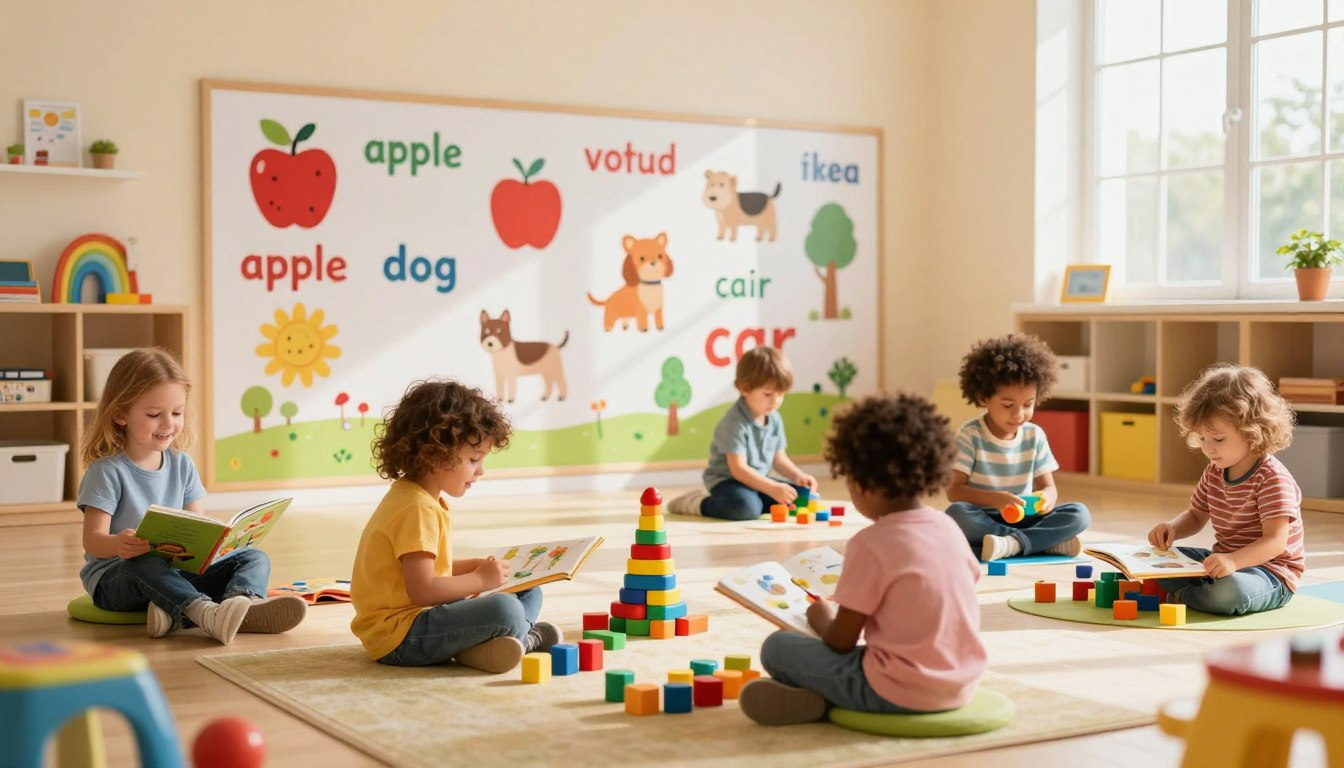
Ludwig Wittgenstein said, “The limits of my language mean the limits of my world.” This is very true for three-year-olds. They start to talk more and understand others better.
Learning new words helps them share their feelings and needs. It’s a big step towards reading and making friends. Parents can make learning fun in everyday life.
Playing games and repeating words makes learning easy. It makes kids feel confident and happy. This way, they learn without feeling stressed.
This guide will show you how to help your child learn to talk. We’ll cover fifty important words and fun activities. It’s easy and fun to help your child learn to talk.
Building Your Toddler’s First English Vocabulary
Early childhood is key for learning language. It’s when toddlers start to talk and understand words. This is a great time for parents to teach new words.
Toddlers learn by seeing and hearing words around them. Talking to your child often helps a lot. Describe what you’re doing and talk about animals and objects.
Talking about daily activities helps a lot. For example, say “We’re washing your hair” during bath time. This teaches new words and their meanings.
Reading together is also great. Pick books with bright pictures and simple stories. As you read, point to pictures and name things. This makes reading fun and helps your child learn.
Here are more tips for teaching your toddler words:
- Use real objects to show what words mean.
- Repeat words and phrases to help them stick.
- Ask your child to repeat words to practice.
- Make learning fun with games and songs.
By making your home a place where language is rich, you help your toddler a lot. Engage in activities that make language fun and exciting.
Why Vocabulary Development Matters at Age Three

Vocabulary growth is key for kids at three. It’s when they start using language in new ways. A big vocabulary helps them talk better.
Craig Selinger, a speech-language therapist, says early speech delays can be fixed. This shows why we must watch and help young kids with their words.
Language Milestones for 3-Year-Olds
By three, kids hit language goals. They say simple sentences and know basic body parts. They also follow simple commands.
At this age, kids know about 1,000 words. They start linking two words together. They also get more complex sentences and follow longer directions.
The Connection Between Words and Cognitive Growth
Learning new words helps kids grow smarter. It helps them understand more and solve problems. This is important for learning new things.
Having a big vocabulary early on helps kids do well in school. It lets them share their thoughts and needs better. This makes learning fun and less frustrating.
How Play Supports Language Learning
Play is very important for learning words. It lets kids hear new words in fun ways. Reading, singing, and games are great for learning basic words for kids.
Play also lets kids try out talking. It helps them connect words with actions. This is how they learn to talk more and better.
Body Parts and Self-Awareness Words
Teaching body parts to young kids boosts their self-awareness and talking skills. Kids are naturally curious about their bodies. It’s a great time to teach them about different body parts.
The 8 Essential Body Part Words
Learning basic body parts is key for toddlers. These words help them know their body parts. They also help their brains grow.
Head, Eyes, Nose, Mouth, Ears, Hands, Feet, Belly
These eight parts are crucial for kids to learn. They help kids understand their bodies. Parents and caregivers can teach these words clearly.
| Body Part | Simple Description |
|---|---|
| Head | The top part of the body |
| Eyes | Used for seeing |
| Nose | Used for smelling |
| Mouth | Used for eating and speaking |
| Ears | Used for hearing |
| Hands | Used for holding and touching |
| Feet | Used for standing and walking |
| Belly | The middle part of the body |
Play Ideas for Body Part Words
Play is a great way for toddlers to learn new words, like body parts. Here are some fun play ideas to help kids learn and remember these words.
Mirror Exploration Activity
Use a mirror to help your child find and name body parts. This activity teaches vocabulary and boosts self-awareness.
This classic song and action game teaches body part vocabulary. It also helps with movement and coordination.
Body Part Painting and Drawing
Do creative activities like painting or drawing body parts with your child. This activity helps them remember these words.
By adding these play ideas to daily routines, parents and caregivers can make learning fun. This helps toddlers learn new words.
Family, People, and Social Words

Teaching 3-year-olds about family and friends is key. They are curious about the people around them. This is a great time to teach them important words.
The 7 Important People Words
There are seven key words for toddlers to learn. These words help them understand family and friends.
Mommy, Daddy, Baby, Brother, Sister, Friend, Teacher
Words like Mommy, Daddy, Baby, Brother, Sister, Friend, and Teacher are important. They show who is in a child’s life. Using these words helps kids understand their family and friends.
- Mommy and Daddy are the main caregivers.
- Baby is a little sibling or a new family member.
- Brother and Sister are siblings.
- Friend is someone they play with.
- Teacher helps them learn.
Play Ideas for People Words
Learning people words can be fun. Here are some play ideas to help toddlers practice.
Family Photo Album Activity
Creating a family photo album is a great idea. It helps kids learn and remember people words. They can say names and relationships as they look at pictures.
Dollhouse and Figure Play
A dollhouse with family figures is fun. It lets kids act out scenarios and use words in context. This play helps them learn language and social roles.
Role-Playing Family Scenarios
Role-playing family scenes is interactive. It lets kids practice vocabulary in a fun way. They learn about different family roles and behaviors.
“Play is the highest form of research.” – Albert Einstein
This quote shows play’s value in learning. Using people words in play boosts a child’s vocabulary and social skills.
Animal Words and Nature Vocabulary

Teaching toddlers about animals is fun. It helps them learn new words and love nature. At three, kids are very curious about the world. Animals are often what they find most interesting.
The 8 Common Animal Words
Learning basic animal names is a great start. Here are eight animal words perfect for toddlers:
Dog, Cat, Bird, Fish, Cow, Pig, Chicken, Horse
- Dog – A common pet at home.
- Cat – Another pet kids love.
- Bird – Seen in backyards or parks.
- Fish – A pet or in aquariums.
- Cow – Found on farms or in pictures.
- Pig – Common on farms.
- Chicken – Seen on farms or in backyards.
- Horse – Often in children’s media.
| Animal | Sound | Where to Find |
|---|---|---|
| Dog | Woof | Homes, parks |
| Cat | Meow | Homes |
| Bird | Chirp | Parks, backyards |
| Fish | Glub glub | Aquariums |
Play Ideas for Animal Words
Play is a great way to help toddlers learn. Here are some fun play ideas for animal words:
Animal Sound Matching Game
Make a simple game where kids match animal pictures with sounds. It helps them learn by sight and sound.
Farm and Zoo Pretend Play
Setting up a pretend farm or zoo is fun. Kids can learn about animals through play. Use toy animals and create stories.
Animal Movement Activities
Get kids moving like animals. They can hop like a chicken or swim like a fish. It’s fun and helps them learn.
By using these play ideas, learning animal words can be fun for toddlers. Parents and caregivers can make it a part of their daily routine.
Food and Mealtime English Words for 3 Year Olds

Teaching 3-year-olds about food words is key for their language growth. At this age, kids learn fast by exploring their world. Mealtime is a great chance to teach new words in a fun way.
The 9 Basic Food Words
Learning basic food words is important for English vocabulary. Here are nine basic food words for 3-year-olds:
Apple, Banana, Milk, Water, Bread, Cheese, Egg, Cookie, Juice
| Food Word | Example Sentence |
|---|---|
| Apple | “Let’s eat an apple.” |
| Banana | “The monkey loves bananas.” |
| Milk | “Drink your milk.” |
| Water | “Have a glass of water.” |
| Bread | “I’ll make some bread.” |
| Cheese | “The pizza has cheese.” |
| Egg | “Let’s boil an egg.” |
| Cookie | “You can have a cookie.” |
| Juice | “Let’s drink some juice.” |
Play Ideas for Food Words
Learning food words can be fun with play activities. Here are some ideas to start:
Pretend Grocery Store Setup
Setting up a pretend grocery store at home is fun. You can label food items and have your child practice saying the names.
Play Kitchen Cooking Activities
Play kitchen activities let kids mimic cooking. They learn to name foods while having fun.
Sorting and Categorizing Food Toys
Sorting food toys into groups is a great game. It helps with vocabulary and thinking skills.
Mealtime Vocabulary Practice
At meals, point out foods and say their names. Encourage your child to repeat after you.
Household Objects and Daily Routine Words
Toddlers learn by exploring. They need to know names of things around them. This helps them understand and talk better.
The 10 Everyday Household Words
Learning about common things at home is fun. Here are ten words to start with:
Ball, Book, Toy, Chair, Table, Bed, Cup, Spoon, Door, Window
- Ball
- Book
- Toy
- Chair
- Table
- Bed
- Cup
- Spoon
- Door
- Window
| Word | Association | Activity Idea |
|---|---|---|
| Ball | Playtime | Rolling, throwing |
| Book | Reading | Storytime |
| Toy | Play | Imaginative play |
Play Ideas for Household Words
Make learning fun with play. Here are some ideas:
Indoor Treasure Hunt Game
Make a list of things to find in the house. This game helps them learn and explore.
Room-by-Room Labeling Activity
Put labels on things in each room. This helps them know what things are called.
Clean-Up Time Learning Game
Call out the name of each thing as you clean. This makes learning fun and part of a routine.
Building Block Furniture Creation
Build furniture with blocks and name each piece. This is fun and helps with learning.
“Play is the highest form of research.” – Albert Einstein
Albert Einstein
Use these ideas to make learning fun for your toddler. It will be a great experience for them.
Action Words, Colors, and Descriptive Vocabulary
Learning action words, colors, and descriptive words is key for toddlers. They are curious and want to talk about what they see.
The 8 Essential Action and Descriptive Words
Teaching toddlers these words boosts their vocabulary. They help kids share their feelings and what they see.
Run, Jump, Sit, Stand, Big, Small, Happy, Sad
- Run and Jump get kids moving.
- Sit and Stand teach about positions.
- Big and Small are for comparing sizes.
- Happy and Sad let kids share their feelings.
Play Ideas for Action Words
Play is a great way to teach new words. Here are some fun ideas for action words.
Simon Says Movement Game
This game teaches words like run, jump, sit, and stand. It’s fun and helps kids learn to follow directions.
Emotion Faces Activity
Making faces for happy and sad helps kids understand feelings.
Opposite Day Play
“Opposite Day” with big and small shows how words can mean different things.
Action Word Charades
Acting out words without speaking helps kids learn through seeing and doing.
Making Vocabulary Learning Fun and Effective
Learning new words is fun for toddlers. It’s not just about knowing lots of words. It’s about making it fun and interactive.
Use Repetition in Natural Ways
Repeating words is key. Repeating words in different contexts helps toddlers learn. For example, use new words during bath time or mealtime.
Songs, rhymes, and stories are great too. They make learning fun and engaging.
Create a Language-Rich Environment
Surround your child with lots of language. Reading books together is a great way to introduce new words. Describe what you’re doing and ask your child to do the same.
Follow Your Child’s Interests
Learning new words is more fun when it’s about something your child loves. If they love animals, learn animal words together.
Keep Practice Sessions Short and Playful
Toddlers get bored easily. Keep learning short and fun. Use games and puzzles to make it exciting.
Celebrate Every New Word
Every new word is something to celebrate. Praise and small rewards help keep your child excited to learn more.
By using these tips, you can make learning fun for your toddler. Create a supportive and engaging environment for vocabulary learning.
Conclusion
Teaching basic words to kids is very important. At three years old, they start to learn about the world. They use simple words to understand things.
By teaching them different words, parents help their kids grow. This helps with thinking and talking skills.
We talked about important words like body parts and animals. We also shared fun ways to learn these words.
Using these words in daily life makes learning fun. It helps kids grow their language skills.
Every new word is a big step for kids. It helps them talk and connect with others better.
Supporting kids in learning words is very important. It helps them express themselves and interact with the world.
FAQ
How many English words for 3 year olds should a child know on average?
Most toddlers know 200 to 500 words by age three. But, every child learns at their own pace. Focus on their progress, not just the number of words.
What are the best ways to improve toddler language skills at home?
Make your home a language-rich place. Talk about what you’re doing, read books together, and have conversations. This helps a lot.
Why is play considered essential for vocabulary for preschoolers?
Play lets kids use words in real ways. For example, playing with a tea set helps them learn “pour,” “cup,” and “hot.”
What should I do if I am concerned about my toddler speech development?
If your child isn’t using simple sentences, talk to a doctor or a speech specialist. Early help is very important.
How can I introduce simple words for young children without using screens?
Use hands-on activities! Label things with tape, sing songs, or play with Sago Mini toys. These are better than apps for learning.