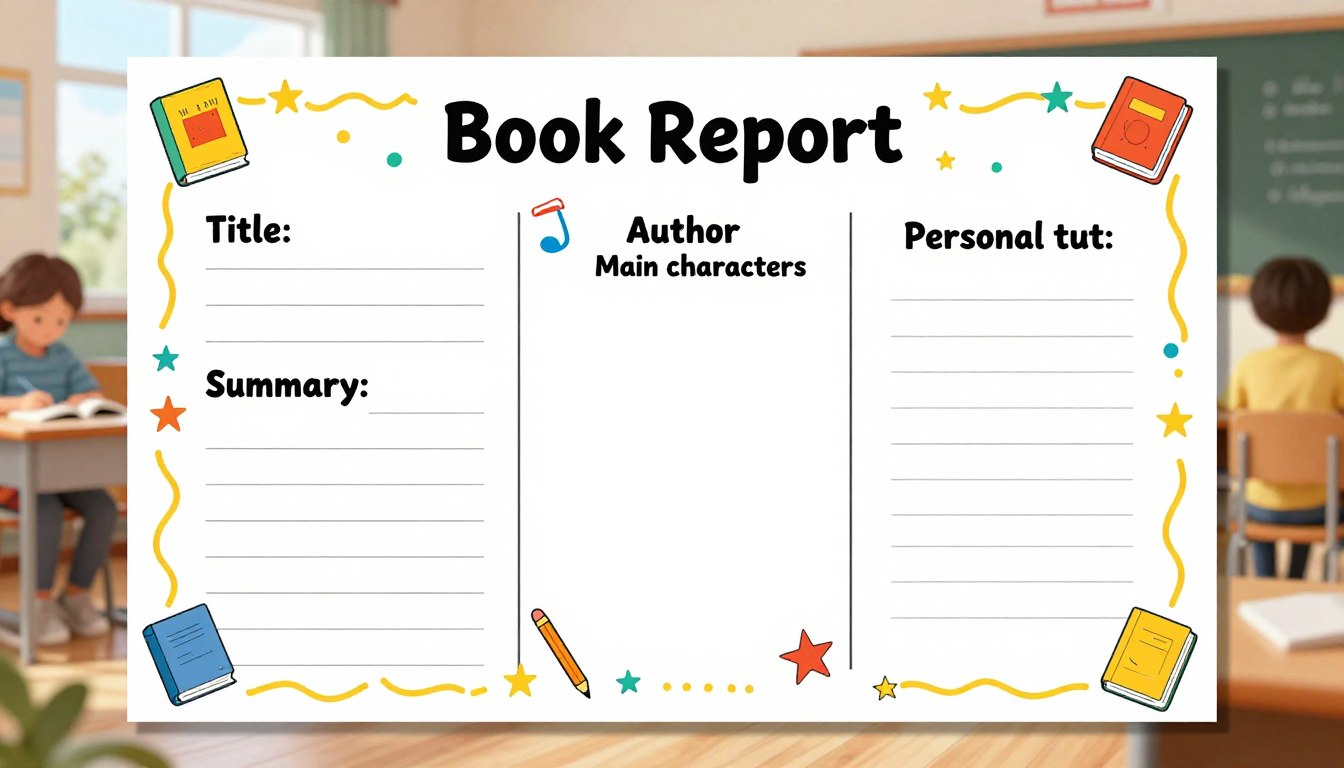
When you finish a great story, you might feel excited but unsure how to share your thoughts. Using a book report outline for kids helps you organize your ideas clearly. It turns a simple summary into a fun way to show what you learned.
A structured approach makes writing much easier. You can focus on your favorite characters or the most exciting plot twists without feeling overwhelmed. Mastering this skill builds confidence in your ability to analyze literature effectively.
Key Takeaways:
- Organize your thoughts after reading.
- Improve your writing skills with a clear framework.
- Showcase your comprehension of the story.
Why a structured approach helps young readers

A good plan makes writing a report fun. It turns a big task into a chance to learn. With a children’s book report template, your child knows what to do.
Building confidence through organization
Young readers might not know where to start. Breaking down big stories into manageable parts helps. It makes them feel they can do it.
Developing critical thinking skills
Following a plan helps students dig deeper. They learn to ask and answer questions. This sharpens their analytical mind.
Making the writing process less intimidating
Many kids get scared by a blank page. A fun book report template makes it easier. It lets them share their thoughts without worrying about the format.
Essential components of a successful book report

A good book report needs a clear structure. This helps you share your thoughts well. Using a elementary school book report template makes sure you don’t miss anything important. It also makes organizing your ideas easier.
The importance of basic bibliographic information
Your report starts with the book’s basic details. This part introduces the book to your reader. You should include:
- The full title of the book
- The author’s name
- The publisher and publication date
- The total number of pages
Setting the stage for the reader
After the basics, introduce the story. Think of this as the “hook” that draws your audience into the world of the novel. Even short stories need a clear summary to help the reader understand the context.
Focus on the main characters and the primary setting. This gives your audience a quick look at the plot. Keep your summary short to avoid spoiling the ending. A structured book report outline for kids helps you stay focused.
Balancing facts with personal reflection
A great report is more than just a summary. You must balance the facts with your own thoughts and feelings. This shows you really connected with the book.
Think about what you liked and which character was most interesting. Sharing your unique view makes your writing engaging and authentic. Your teacher wants to hear your thoughts, so be honest about the book.
The ultimate book report template for kids

A good book report starts with a clear plan. This book report template for kids helps you stay on track. It guides you from the first word to the last.
Overview of the standard layout
Every story has a start, middle, and end. Knowing this helps you write better. A standard layout begins with the title and author.
It then moves to a summary of the story. Lastly, you share your thoughts.
A simple book report template makes big books easier. It helps you focus on key points. This includes character growth and the main conflict.
How to use this printable book report template
Begin with the basic info sections. This printable book report template helps you. It guides you to list the setting and main characters first.
After that, dive into the plot. You can find a free book report template online. It has boxes for each part. Write a few sentences for each to keep it simple.
Customizing the structure for different genres
Every book is different. Feel free to change your approach. For mysteries, add sections for clues and suspects.
For fantasy, describe the magical world and creatures. Making your printable book report template unique makes writing fun. It shows you understand different story types better.
How to write a compelling hook and summary

Every great book report starts with a hook that grabs your attention. This hook invites your reader to join you in the story. It’s key to keeping them interested from start to finish.
Crafting an opening that grabs attention
Your first sentence is like a door to your thoughts. It should be bold, clear, and about the book’s main theme.
Techniques for a strong first sentence
To make a strong start, try these methods:
- Ask a thought-provoking question about the character’s struggle.
- Start with a surprising fact or a bold statement about the setting.
- Use a vivid description of the most exciting moment in the book.
Remember, aim to make your reader curious. Don’t start with simple phrases like “I read a book about…” Jump into the action.
Summarizing the plot without spoilers
After hooking your reader, give a clear summary. You should identify the theme and explain the story’s arc, as per RL.4.2.
Focusing on the beginning, middle, and end
A good summary doesn’t tell the whole story. It highlights key parts of the plot, keeping the ending a surprise.
“A good summary is like a map; it shows the reader where the story is going without revealing every hidden treasure along the way.”
Here’s a simple way to organize your summary:
- The Beginning: Introduce the main characters and their main problem.
- The Middle: Describe the most important events leading to the climax.
- The End: Talk about how the characters solve the conflict without revealing the twist.
By using this book report outline for kids, your summary will be clear and effective. It shows you understand the text and keeps your writing engaging.
Analyzing characters and their development

When you analyze characters, you become a detective in your own story. You learn more about the story by looking at the characters. A fun book report template helps you organize your thoughts.
Describing the protagonist
The main character, or protagonist, drives the story. Look beyond their name and looks. Think about their personality traits, like bravery or shyness. How do these traits affect their actions?
Understanding character motivations
Characters make choices for reasons. Knowing what they want reveals their motivation. What do they aim to achieve or solve? This explains their actions and decisions.
Tracking how characters change over time
Characters evolve from start to finish. A good story shows their growth or mistakes. Use a table to track these changes.
| Character Trait | Beginning of Story | End of Story |
|---|---|---|
| Confidence Level | Unsure and quiet | Bold and assertive |
| Main Goal | Finding a lost item | Helping a friend |
| Key Belief | Afraid of change | Embracing new challenges |
By filling out this table, your writing becomes more insightful. A fun book report template makes this process rewarding, not a chore.
Exploring the setting and its impact on the story
The setting of a novel is like a silent character. It shapes every event in the plot. When you use an elementary school book report template, describe where and when the story happens. This helps your reader understand the world the author created.
Defining the time and place
To start, identify the specific time period and location of the story. Ask if the book is set in the past, present, or a fantasy world. Clearly stating these facts provides the foundation for your entire report.
Think about if the location is a real city or an imaginary land. Identifying these details helps you meet the requirements of your elementary school book report template. It shows you understand the text deeply.
How the environment influences the plot
The environment often forces characters to make difficult choices. For example, a story set in a harsh winter will have different challenges than one set on a sunny beach. Explain how the surroundings create obstacles for the protagonist.
Consider these questions to analyze the impact of the setting:
- Does the weather change the mood of the story?
- Would the plot work if the story happened in a different place?
- How do the buildings or landscapes affect what the characters can do?
Using sensory details to describe the world
Great writers use sensory details to make a setting feel real. You can do the same by describing what the characters see, hear, smell, or touch. Strong descriptions allow your reader to visualize the world alongside you.
Try to include at least one specific example from the book that highlights the setting. Using these sensory clues proves you paid close attention to the author’s craft. It turns a simple summary into a vivid exploration of the story’s world.
Identifying the main conflict and resolution
Every good story has a main problem that pushes the characters to act. A simple book report template helps you see how the story moves from problem to solution. This shows the story’s deeper meaning or moral.
Recognizing the central problem
The main problem is what the hero faces in the book. It’s the big obstacle that stops them from getting what they want. Look for when the hero knows they must act to change things.
Spotting this early makes writing easier. Think about these common conflicts:
- Character vs. Self: A battle with personal choices or feelings.
- Character vs. Character: A fight with a bad guy or rival.
- Character vs. Nature: Facing storms, animals, or survival challenges.
The climax of the story
The climax is the most intense part of the story. It’s the turning point where everything is at its highest tension. In your simple book report template, describe the “big showdown” or the most thrilling scene.
Think of the climax as the moment of no going back. The hero must face their fears directly, and the story’s outcome often depends on this moment. It’s the part that keeps you reading late into the night.
How the characters overcome obstacles
After the climax, the story moves toward the resolution. Explain how the characters solve their problems. Focus on the actions or lessons that helped them succeed.
Ask yourself these questions to fill out your simple book report template:
- What specific skills did the character use to win?
- Did the character change their mind or behavior to solve the issue?
- What was the final result of their hard work?
By following these steps, you show you really get the characters’ journey. This level of detail makes your writing shine and shows you can break down complex plots easily.
Sharing your personal opinion and recommendations
Your unique view makes a book report special. This part is where you can really show off. A free book report template helps you share your thoughts clearly.
Formulating your own critique
Think about how the story was told. Was the pace good or slow? Did the characters feel real?
Also, was the book’s message clear? A good critique talks about how well the author shared the message. Use a free book report template to jot down your thoughts.
“A book is a dream that you hold in your hand.”
Neil Gaiman
Explaining why you liked or disliked the book
Be honest about your feelings. If you loved it, say what excited you. If not, explain why without being harsh.
Use specific examples from the book to back up your opinion. Did a scene change your mind about a character? Was the ending a surprise you enjoyed?
Who would enjoy reading this novel
Think of friends or classmates who might like it. Recommend it based on the genre or themes. For example, if it’s a mystery, suggest it to puzzle lovers.
Sharing your recommendation is a great way to end. A free book report template helps you organize your thoughts. Your advice might help someone find their next favorite book!
Creative ways to present your book report
Make your book report fun by turning it into a creative project. A elementary school book report template is a good start. But, you can make it more interesting by using different ways to show your understanding. Thinking outside the box makes your report personal and fun.
Moving beyond the standard essay format
You don’t have to stick to just writing. Today’s tech lets you interact with books in new ways. For example, Goosechase lets teachers make digital scavenger hunts. This turns your report into a fun game.
Use a creative book report template to make digital slides or interactive journals. These formats let you focus on the story’s key parts. You might even make a video or podcast to share your thoughts with others.
Using visual aids and posters
Visuals are great for telling stories. Making a poster or diorama brings the book to life. Use colors and drawings to show the story’s key moments.
Visual projects add to your written report. They show off your art skills and the book’s themes. When you show your poster, it gives others a clear view into the book’s world.
Incorporating oral presentation elements
Talking about your book is as important as writing about it. It helps you feel more confident and improves your speaking. You can share your favorite parts or why you like the book.
Here’s a table to help pick the best way to present your book:
| Presentation Method | Primary Benefit | Best For |
|---|---|---|
| Digital Scavenger Hunt | Interactive Engagement | Tech-savvy students |
| Visual Poster Board | Artistic Expression | Visual learners |
| Oral Book Talk | Public Speaking | Building confidence |
| Video Review | Creative Storytelling | Modern media fans |
Choose a digital or hands-on approach to share your view. A flexible elementary school book report template helps you cover the basics. It also lets you add your own creative flair.
Tips for editing and polishing your writing
Reviewing your book report is key to making your message clear and professional. Whether you used a printable book report template or wrote it yourself, editing is where your ideas shine. Consistency in your presentation helps your teacher focus on your analysis, not formatting errors.
Checking for clarity and flow
First, make sure your report is in standard manuscript format. Use Times New Roman, 12pt font, and double-spaced lines for easy reading. Also, check that each paragraph flows smoothly into the next, guiding your reader through your thoughts.
“The beautiful part of writing is that you don’t have to get it right the first time, you just have to get it right the last time.”
— Ray Bradbury
Correcting common grammar and spelling mistakes
Look closely for small errors that might distract from your hard work. Focus on subject-verb agreement and keep your verb tenses the same. A spell-check tool is helpful, but always double-check for words that are spelled right but used wrong.
The value of reading your work aloud
Reading your report out loud is a great way to find awkward phrasing. When you hear your words, you’ll quickly spot any clunky or confusing parts. If you stumble over a part, it’s a sign to rewrite it for a better printable book report template final draft.
Conclusion
Writing about books changes how you see stories. A good children’s book report template helps you organize your thoughts. It makes exploring complex themes easier.
Breaking down characters and plots helps you understand them better. This builds your confidence as a writer. You’ll get better at sharing your thoughts with every book you read.
Trying out a creative book report template lets you show your unique style. Your work can be a traditional essay or a visual project. It shows how you connect with the book.
Start using these tips on your next favorite novel. You can make your analysis special and share your love for reading. Reading becomes more fun when you’re curious and have a plan.
FAQ
Q: Where can I find a free book report template for my homework?
A: You can find free book report templates on websites like Scholastic and ReadWriteThink. They let you download and print them for your school work.
Q: Is there a children’s book report template suitable for 1st or 2nd graders?
A: Yes, there are templates for young kids. They usually ask for drawings and short sentences about the story.
Q: Why should I use a printable book report template instead of a blank notebook?
A: Printable templates have boxes for important info. They help you remember to include things like the author and your rating.
Q: How can an elementary school book report template improve my writing?
A: These templates teach you to organize your thoughts. You learn to move from basic facts to deeper analysis.
Q: What makes a fun book report template different from a boring one?
A: Fun templates have creative sections. They might ask you to design a new cover or interview a character.
Q: Can I use a simple book report template for non-fiction books?
A: Yes, you can adapt simple templates for non-fiction. Just change “plot” to “main facts” and “characters” to “important people” or “topics.”
Q: How does a creative book report template help with public speaking?
A: Creative templates, like making a “book in a box,” give you a visual aid. This makes presenting your report more fun and easy.
Q: Is a book report outline for kids helpful for long novels?
A: Absolutely. Outlines are great for long books like Percy Jackson. They help you keep track of characters and events.